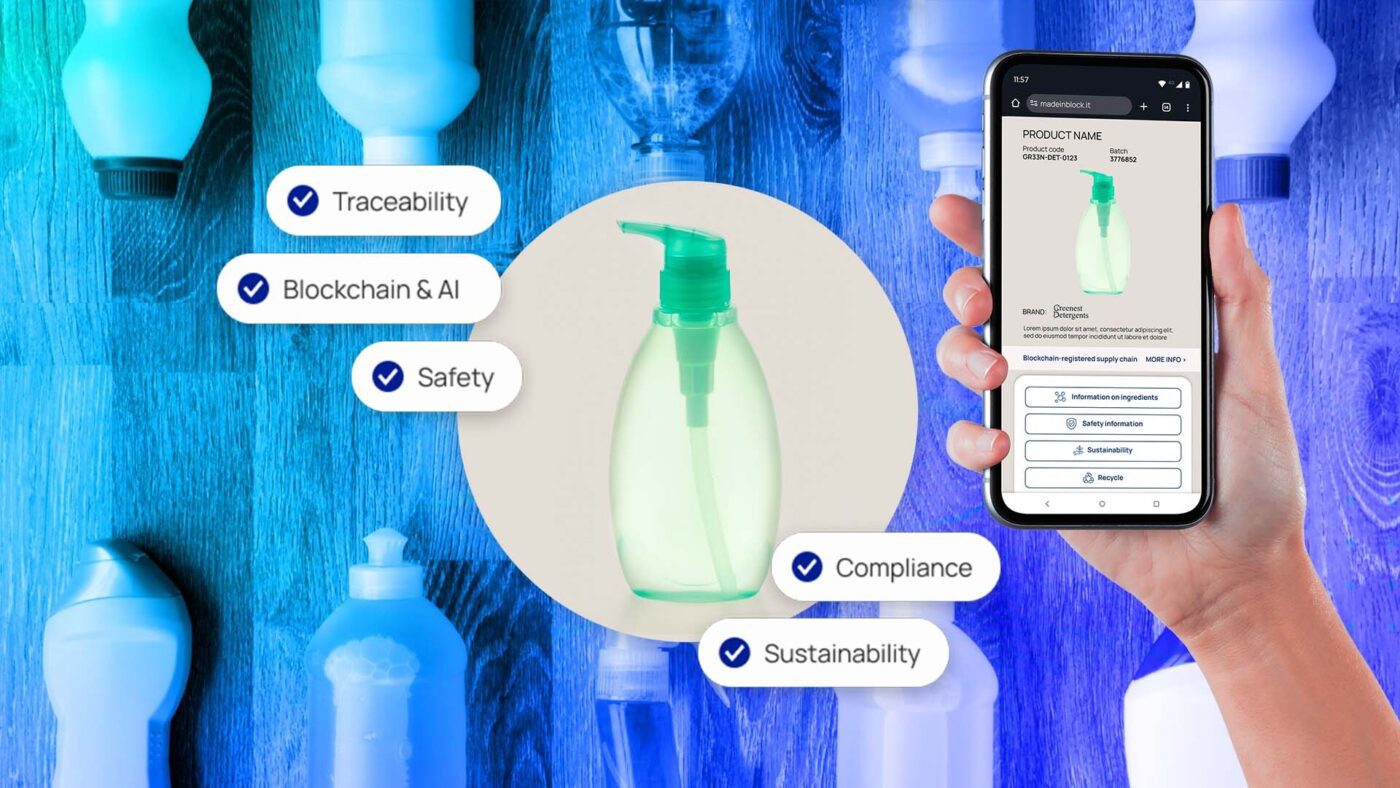














The European Parliament has approved the introduction of the Digital Product Passport for detergents and surfactants to improve the mandatory requirements regarding safety, environmental protection, labeling information, market surveillance, and transparency for authorities, healthcare systems, and poison control centers. The new regulation introduces the adoption of a Digital Product Passport for detergents and surfactants in order to better safeguard people and the environment. Furthermore, the DPP guarantees clearer and more accessible information for authorities, economic operators and consumers. This solution abrogates the 648/2004 Regulation and updates the 2019/1020 UE Regulation on market surveillance. It is also going to be included in the regulatory framework of REACH, CLP and the 528/2012 UE Regulation, without abrogating them and aligning the legislation on detergents and surfactants with the latest chemical and surveillance rules of the market.
Already interested? Request a free consultation to have access to legal support, operational development and continuous assistance to meet any requirement.
Reading time: 8 minutes
Index
- What is a Digital Product Passport for Detergents and Surfactants?
- The Regulation and the Digital Product Passport for Detergents and Surfactants
- Why Blockchain is necessary for the DPP for Detergents and Surfactants
- The Benefits of the Digital Product Passport for Detergents and Surfactants
- Why choose EZ Lab for the Digital Product Passport for Detergents and Surfactants?
- FAQ about the Digital Product Passport for Detergents and Surfactants
What is a Digital Product Passport for Detergents and Surfactants?
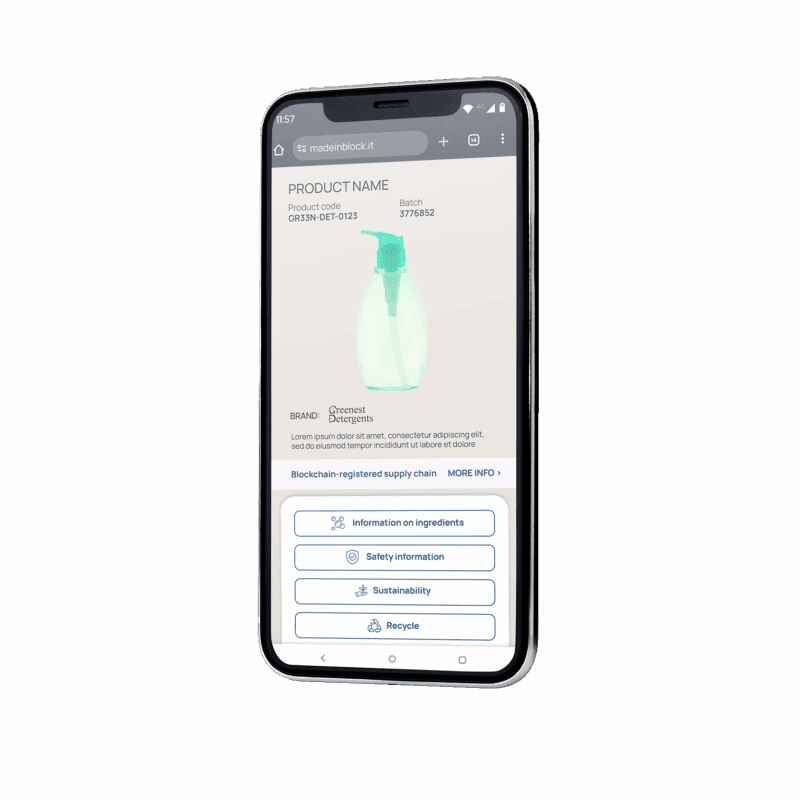
The Digital Product Passport (DPP) is the product’s digital identity, accessible directly from the product itself via QR code or NFC Tag. It is a structured set of product and component information designed to support safety, circular economy and sustainability within the EU market.
This tool provides detergents and surfactants with a unique digital identity, including information covering the entire product lifecycle such as origin, composition, durability, and recyclability. In this way, stakeholders across the value chain can easily access these data.
On January 22, 2026, the European Parliament approved the introduction of the Digital Product Passport for detergents and surfactants, making it mandatory for these products. The DPP has been already established as a mandatory tool under the ESPR Regulation. It is now being applied to the detergents market as well, strengthening transparency, traceability and accessibility of information across the entire supply chain.
The Regulation and the Digital Product Passport for Detergents and Surfactants
The new regulation on detergents and surfactants does not only concern chemical manufacturing, but also machinery producers, service companies and public administrations. This regulation aligns with the objectives set by the Green Deal, simplifying the circulation of detergents and surfactants while ensuring high standards of safety and sustainability.
In particular, among the news about detergents and surfactants there are:
- Rules on microorganisms to provide the professional market with probiotic solutions required in sustainable hygiene protocols;
- Sustainability measures related to refill systems;
- Clearer labeling with reduced bureaucratic burden for companies;
- A ban on animal testing for the production of detergents;
- Criteria of biodegradability for the detergents’ ingredients and the polymeric films used in detergent capsules and tablets;
- A Digital Product Passport (DPP) for detergents and surfactants that provides all relevant information through digital labeling.
Why Blockchain is necessary for the DPP for Detergents and Surfactants
Blockchain is a technology that functions as an immutable, public and secure digital ledger. It guarantees data security and simplifies compliance with increasingly stringent sustainability and traceability regulations. At the same time, it allows companies to make declarations that are tamper-proof and verifiable by third parties.
Blockchain is a technological solution that meets the technical requirements set out in the regulation which calls for data authenticity, data reliability and high levels of security and privacy. It also guarantees that information recorded in the Digital Product Passport for detergents and surfactants cannot be retroactively modified.
The Benefits of the Digital Product Passport for Detergents and Surfactants
The Digital Product Passport for detergents and surfactants is a tool established by the European Union within the scope of the ESPR Regulation. It will be applied to detergents and surfactants according to the sector’s regulatory framework. The implementation of the DPP for detergents and surfactants allows to achieve and monitor sustainability, biodegradability and circular economy purposes. In this way there can be an optimization of the supply chain and each organization can add value to the product and process data for stakeholders, authorities and end users.
Furthermore, consumers will have access to clearer and easily accessible data thanks to a physical label accompanied by a digital one containing additional information. The Digital Product Passport will guarantee accuracy, reliability and compliance of the product’s data in relation to safety standards, notwithstanding that the compliance is still under the economic operator’s responsibility.
Why choose EZ Lab for the Digital Product Passport for Detergents and Surfactants?
EZ Lab is specialized in creating digital product identities with blockchain traceability. Thanks to our expertise, we have developed the proprietary Made in Block solution, designed to provide differentiated access levels based on user authorization for supervisory authorities, supply chain stakeholders, and end customers. The platform integrates with company systems without adding workload to staff and enables automated issuance of the Digital Product Passport for detergents and surfactants. Regulatory compliance thus becomes a new opportunity for product enhancement. We offer a complete service able to help you fulfill the regulation within the deadline and create added value.
Legal Advice
The European regulatory landscape is rapidly evolving. For this reason, our legal experts will continuously support you in regulatory compliance.
DPP Platform for Detergents and Surfactants
We automatically collect supply chain data and customize the Made in Block platform according to the requirements and your needs for the creation of your DPP.
Marketing
The obligation to provide adequate information for your clients represents an opportunity to enhance transparent communication and establish with them a long-lasting relationship.
Operational Support
A single point of contact is going to provide operational and customized support to guide you through the creation and updating of the Digital Product Passport for detergents and surfactants.
Thanks to our multidisciplinary team we can create your Digital Product Passport for detergents and surfactants. To this day, we have more than 200 million traced products in blockchain and more than 250 fulfilled successful stories.
Request your free consultation to discover how to further enhance the value of your products.
FAQ about the Digital Product Passport for Detergents and Surfactants
The new EU Regulation on detergents and surfactants was approved by the European Parliament on 22 January 2026 and will be published in the Official Journal of the European Union. It will enter into force 20 days after publication. In the meantime, it is necessary to activate the Digital Product Passport structure, so that the mandatory data can be inserted quickly once the requirements are fully defined.
Starting now with the DPP makes it possible to turn a regulatory obligation into a competitive advantage: existing data can be mapped, including data sheets, compositions, documentation and carbon footprint, and any gaps can be identified. In addition, differentiated access can be managed for authorities, stakeholders and consumers, creating a digital channel that enhances the supply chain and the company, while promoting informed purchasing decisions.
The purpose of the DPP is to help manage the supply chain more effectively by making information on each stage and component of the product more accessible, for example enabling verification of the sustainability certifications of suppliers’ raw materials. The supply chain will become more transparent, with unified and verifiable information.
Yes, it will be necessary to add to the physical label a QR code or another equivalent mean that allows free access, in multiple languages, to the data without the need for registration, apps or passwords.
No, the digital label does not replace the physical label. Laundry detergents sold at refill stations may be provided only with a digital label, with the exception of dosing information, which must also be present on a physical label.