














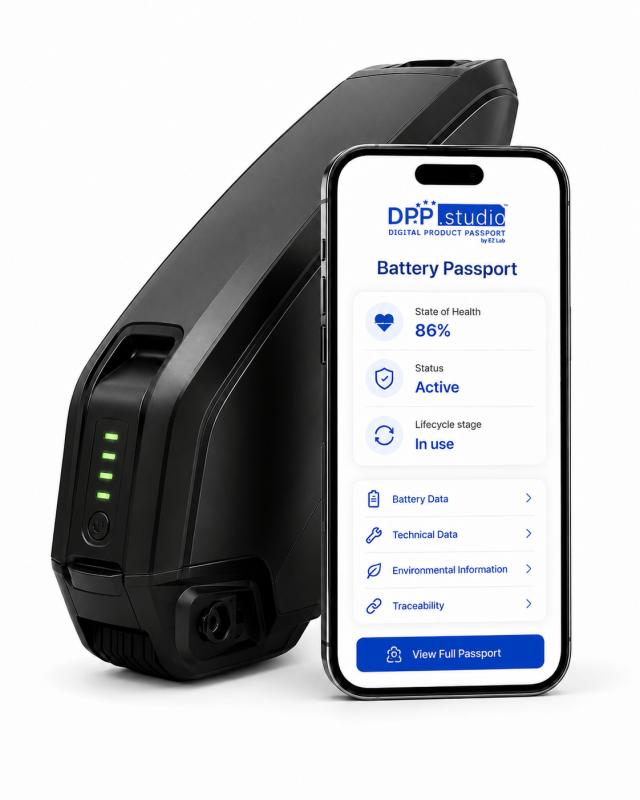
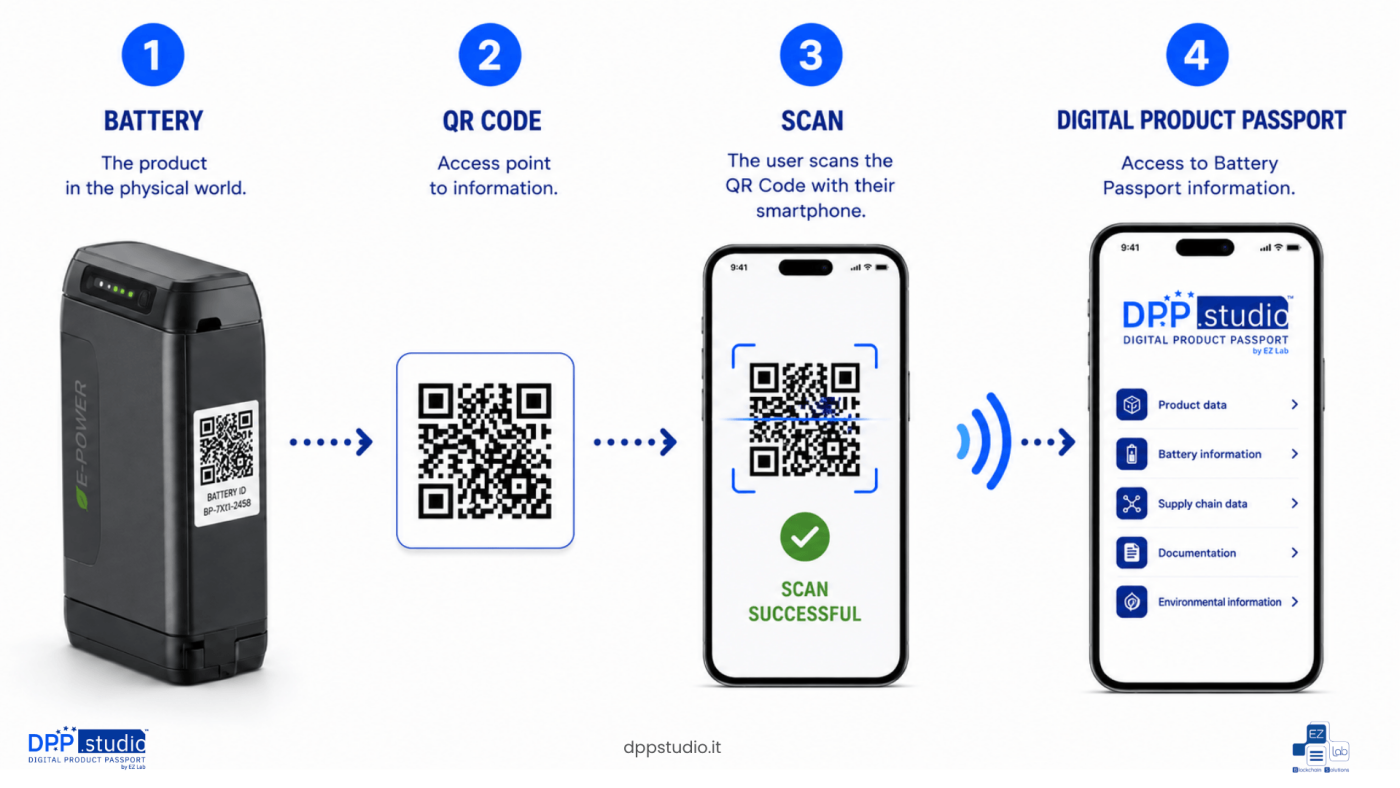
The Battery Passport is an electronic record connected to a battery through a unique identifier and accessible via a QR Code. It brings together information about the battery model, origin, technical characteristics, composition, carbon footprint and life cycle management. For some battery categories, it may also include data related to the individual unit, such as its state of health and remaining capacity. The Battery Passport is therefore more than a webpage linked to a product. It is a digital infrastructure designed to organise, update and share data with consumers, authorities and supply chain operators through different access levels.
Update – August 21, 2026: the list of required data has been made public
The European Commission has published a list of mandatory and optional data fields, also specifying the dates from which additional data will be required to create a compliant Battery Passport.
Five key takeaways
- From 18 February 2027, all batteries will need a QR Code providing access to the information required by the regulation. Electric vehicle batteries, light means of transport batteries and industrial batteries above 2 kWh will require a complete Battery Passport. DPP Studio supports both requirements.
- The QR Code is only the access point. The real value lies in the digital infrastructure that organises product data, supply chain information, access levels and updates.
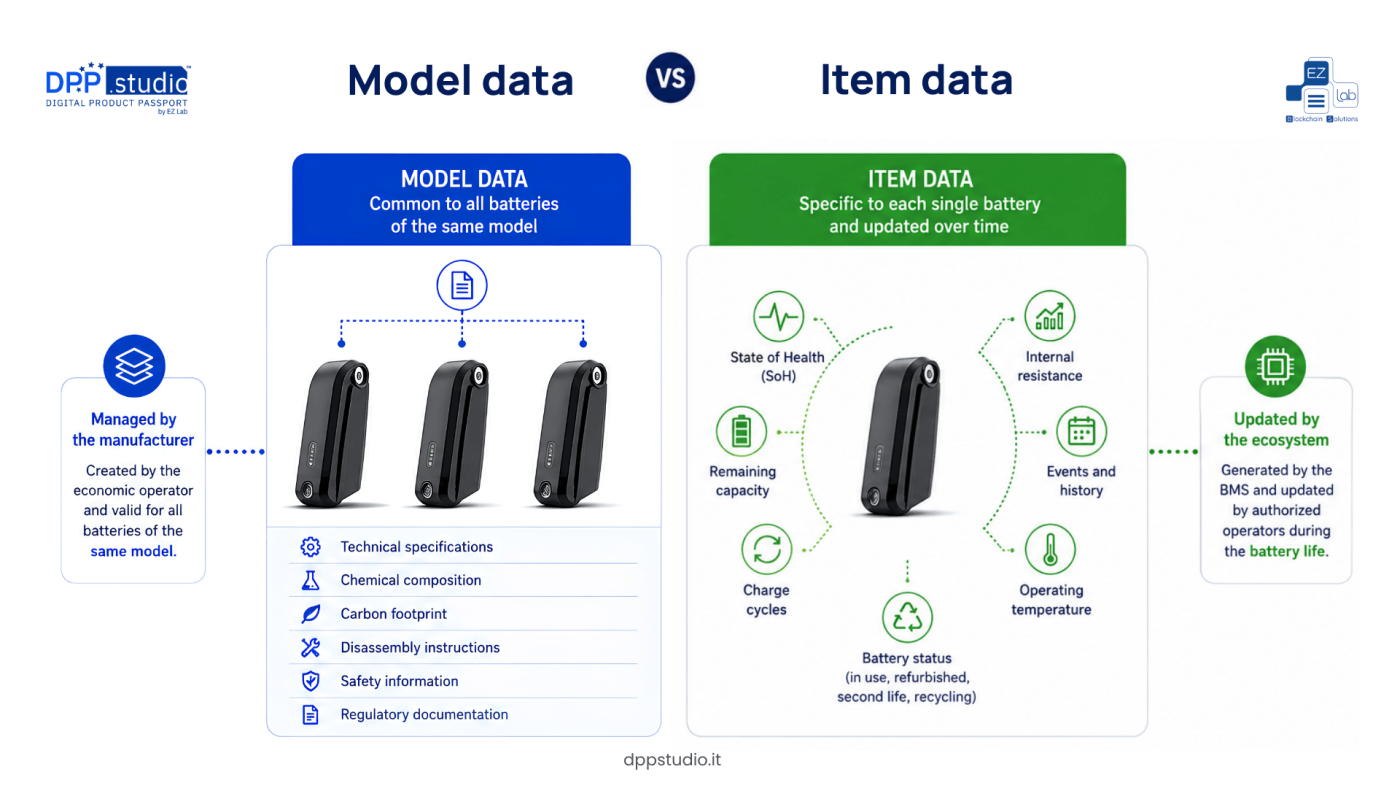
- Model data and item data serve different purposes. Shared information describes the battery model, while dynamic information may describe the condition and history of the individual unit.
- Companies need to connect data, systems and responsibilities. Preparing for the Battery Passport means identifying data sources, defining ownership and integrating systems such as ERP, PLM and BMS.
- DPP Studio turns Battery Passport data into business value. It helps companies create updatable passports, manage differentiated access and maintain information continuity across maintenance, second life and recycling.
Table of Contents
- Is the Battery Passport required for every battery?
- What is a Battery Passport?
- What regulation introduces the Battery Passport?
- What information does a Battery Passport contain?
- Public information and restricted-access data
- Model data and individual battery data
- How is battery State of Health measured?
- How is Battery Passport data updated?
- Carbon footprint in the Battery Passport
- Unique identification and QR Code
- Battery Passport and second-life applications
- The role of the Battery Passport in recycling
- Why is the Battery Passport important for companies?
- How to prepare for the Battery Passport
- DPP Studio for Battery Passport
- Frequently asked questions about the Battery Passport
- Conclusion
Is the Battery Passport required for every battery?
No. From 18 February 2027, all batteries will need to carry a QR Code providing access to the information required under Regulation (EU) 2023/1542. However, the Battery Passport introduced by Article 77 of the regulation will apply only to electric vehicle batteries, light means of transport batteries, including those used in e-bikes and electric scooters, and industrial batteries with a capacity greater than 2 kWh.
For these categories, the QR Code will provide access to an electronic record containing model-level information and, where applicable, data related to the individual battery. For other battery categories, including common AA batteries and button cells, the QR Code will instead provide access to the specific information required by the regulation.
What is a Battery Passport?
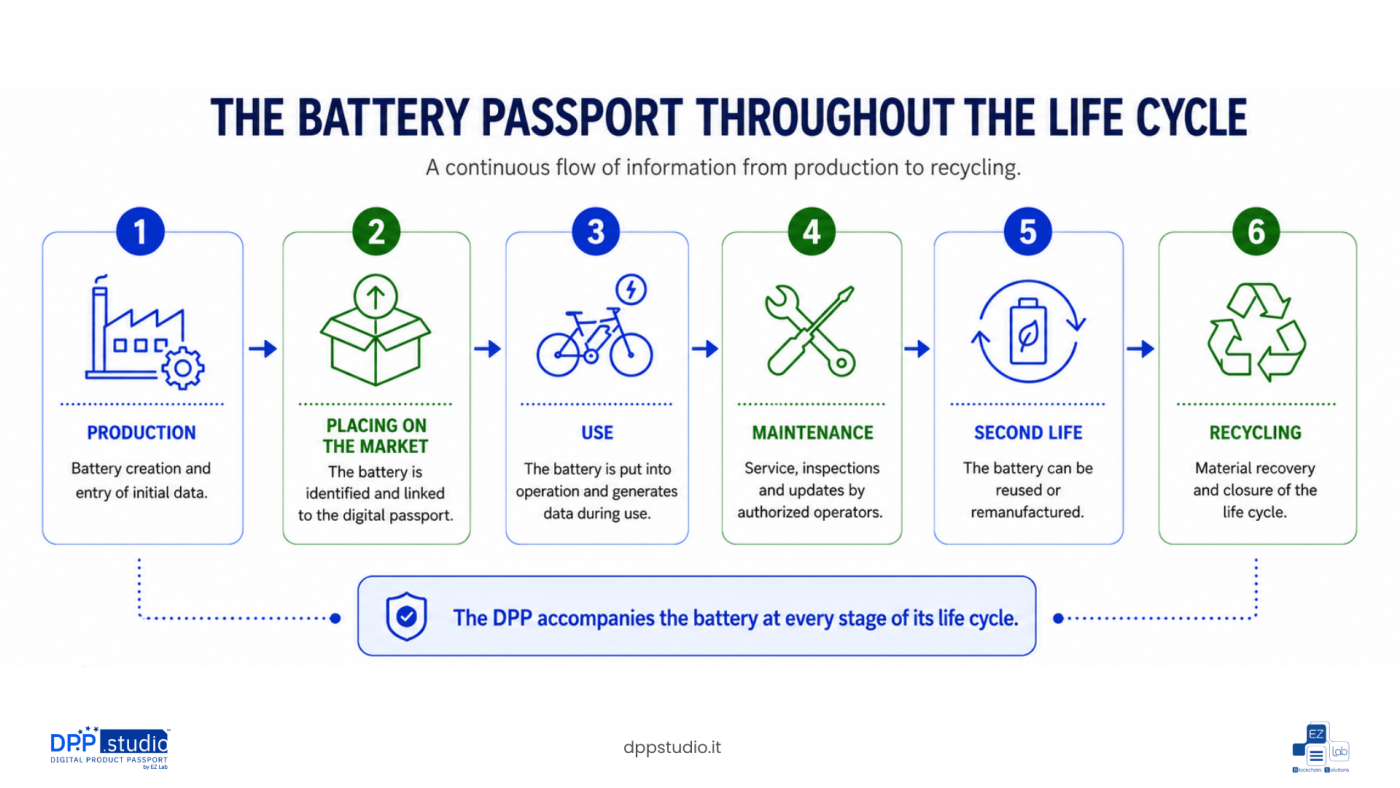
A Battery Passport is an electronic record associated with a specific battery. It includes information relating to the battery model and, when required and available, data connected to the individual unit. This structure avoids unnecessary duplication by managing shared information, such as chemical composition, nominal capacity and carbon footprint, at model level, while data that changes during use can be associated with the individual battery. The passport can therefore accompany the battery from production and market placement through use, maintenance, second life and recycling.
What regulation introduces the Battery Passport?
The main legal reference is Regulation (EU) 2023/1542 concerning batteries and waste batteries. Article 77 introduces the Battery Passport and defines its scope, while Annex XIII identifies the categories of information that the passport must contain. The regulation requires the Battery Passport to be linked to the physical battery through a QR Code and a unique identifier. Information must be structured, machine-readable, based on open standards and managed through an interoperable system. Rather than simply making more data available, the goal is to ensure that each stakeholder can access the information relevant to their role, while confidential or technically sensitive data remains protected.
What information does a Battery Passport contain?
The content of a Battery Passport depends on the battery category and on the access rights of the person viewing it. Model-level information may include the manufacturer’s identity, place and date of production, battery category, weight, nominal capacity, voltage, chemical composition and expected performance. The passport may also provide environmental information, including the carbon footprint and recycled content, together with documentation and instructions supporting maintenance, disassembly and end-of-life management. Not all information is available to every user. Some data is public, while other information is reserved for authorities or operators involved in repair, remanufacturing, second-life applications and recycling.
| Public data | Restricted-access model data | Restricted-access individual battery data |
|---|---|---|
| Manufacturer | Detailed material composition | State of health, when available |
| Battery category | Component and spare-part codes | Remaining capacity |
| Place and date of production | Disassembly instructions | Number of charge and discharge cycles |
| Capacity, voltage and weight | Safety procedures | Internal resistance |
| Chemical composition | Maintenance and repair information | Relevant events and recorded operating conditions |
| Carbon footprint | Information for reuse and recycling | Battery status: original, repurposed, reused, remanufactured or waste |
The information available depends on the battery category, the applicable requirements and the user’s access level. Dynamic data also requires systems or processes capable of generating and updating it.
Public information and restricted-access data
Scanning the QR Code does not necessarily provide unrestricted access to the complete Battery Passport. Consumers may view public information concerning the product, its origin, technical characteristics and selected environmental data. Authorities can access information required for market surveillance and control activities. Specialised operators may receive more detailed information when it is necessary for repair, disassembly, remanufacturing or recycling. Different access levels are therefore a central feature of the Battery Passport, allowing the system to improve transparency while protecting data security, intellectual property and confidential business information.
Model data and individual battery data
The Battery Passport combines two information levels. The first includes information shared by all batteries belonging to the same model. This may include nominal technical specifications, chemical composition, carbon footprint, technical documentation, safety information and disassembly instructions. The second level concerns the individual battery. It may include information generated during use, such as battery status, maintenance activities and selected performance parameters. The Battery Passport can therefore describe both how a battery was designed and produced and, when the necessary systems are available, what happened to that specific unit over time.
How is battery State of Health measured?
The State of Health, commonly abbreviated as SoH, describes the condition of a rechargeable battery compared with its initial performance. The Battery Passport does not calculate State of Health, nor does the QR Code measure the battery. Instead, the relevant operating parameters must be measured, stored or estimated by an electronic system or technical process. In more advanced batteries, this role is performed by the Battery Management System, or BMS. The BMS manages the battery’s electrical and thermal functions and may provide data used to determine its condition and expected lifetime. This distinction is important because not every battery subject to the Battery Passport requirement generates the same dynamic data. State of Health information depends on the battery category, its technology and the electronic systems installed.
How is Battery Passport data updated?
The Battery Passport may be managed by several organisations and systems throughout the battery life cycle. The economic operator placing the battery on the market is responsible for ensuring that the information contained in the passport is accurate, complete and up to date. Other parties may be authorised to enter or update specific data on its behalf. During use, the BMS may provide relevant operating parameters, while maintenance operators can add information about inspections, repairs and component replacements. Operators involved in repurposing, remanufacturing or recycling may then update the battery’s status and provide information related to the next stage of its life cycle. This does not mean that every data point must change continuously. Some information remains stable, while other fields are updated only after a relevant event. For companies, the challenge is to determine where each piece of information originates, who is authorised to modify it and how it remains connected to the correct battery.
Carbon footprint in the Battery Passport
The battery carbon footprint is generally associated with the battery model and its production conditions. Its calculation considers the stages required by the applicable methodology, which may include raw material sourcing, production, distribution and end-of-life management. Results are expressed in kilograms of CO₂ equivalent per kWh. Unlike State of Health, the carbon footprint does not change according to how each individual battery is used. It may instead require an update when relevant elements of the model or production process change, such as materials, the bill of materials or the energy mix used at the manufacturing facility. The Battery Passport therefore manages different types of information, but not every data category follows the same update process.
Unique identification and QR Code
The QR Code is only the access point to the Battery Passport. Behind it, a digital system connects the physical battery to the correct electronic record. Each battery concerned must be linked to a unique identifier to avoid confusion between models, batches and individual units. The infrastructure can also connect the battery with the manufacturer, production facility, components and other identifiers required for traceability. The value of the Battery Passport is therefore not created by the QR Code alone. It depends on the quality, organisation and continuity of the information that the code makes accessible.
Battery Passport and second-life applications
A battery that is no longer suitable for its original purpose does not necessarily need to be sent directly for recycling. Depending on its condition, the battery may be repaired, remanufactured or repurposed for a less demanding application. Evaluating these options requires reliable information about its remaining capacity, operating history, relevant events and maintenance activities. The Battery Passport can make this information available to authorised operators, supporting more informed decisions about the battery’s remaining useful life. When a new passport is created following remanufacturing or repurposing, its connection with the original record can preserve the continuity of information.
The role of the Battery Passport in recycling
At the end of the battery life cycle, information about chemistry, materials, components, disassembly procedures and safety requirements can help operators manage the product more effectively. Recyclers can access the information relevant to their activities without having to reconstruct the battery composition from the beginning. This can support material recovery and the selection of suitable treatment procedures. The Battery Passport therefore creates information continuity between the company producing the battery, the organisation using it, the operator evaluating a second-life application and the recycler managing its end of life.
Why is the Battery Passport important for companies?
The Battery Passport requires companies to move beyond fragmented information management. Relevant data may be stored in several systems, managed by different departments or provided by suppliers and external partners. Creating a Battery Passport requires companies to identify which information is available, which data is missing, who is responsible for it and when it must be updated. The project can therefore involve production, IT, sustainability, quality, maintenance and supply chain teams. The QR Code is only the visible result of an information architecture that must first be designed and implemented. At the same time, the Battery Passport can create value beyond regulatory readiness. Structured data can support maintenance, second-life decisions, recycling processes and collaboration between supply chain stakeholders.
How to prepare for the Battery Passport
The first step is to verify whether the batteries placed on the market by the company fall within the categories covered by the requirement from 2027. The company must then distinguish model-level information from data associated with the individual battery. It should identify the original sources of each data point, assess which systems can provide the information and define the appropriate access levels. Dynamic data requires particular attention. Before including State of Health or other changing parameters in the Battery Passport, the company must verify whether the battery has a BMS or whether another reliable process can generate the required information. Preparing for the Battery Passport means building an information infrastructure that connects products, people, processes and company systems throughout the battery life cycle.
DPP Studio for Battery Passport
DPP Studio is the EZ Lab solution for creating and managing Battery Passports through a flexible digital platform. The platform connects the physical battery with its electronic passport through a QR Code and separates public information from content intended for authorities or authorised operators. DPP Studio integrates with company systems and data sources to manage both model-level information and data related to the individual battery. When available, parameters generated by the Battery Management System can also flow into the passport, helping keep product information up to date throughout the battery life cycle. The solution helps companies organise technical, environmental and supply chain information, manage access levels and maintain data continuity through maintenance, second-life applications and recycling. From storytelling to storyproving, EZ Lab enables every product to become a communication hub, sharing a story based on data that can be verified by consumers and stakeholders.
DPP Studio also supports the QR Code requirements for other battery categories, helping companies organise and provide access to the applicable information required by the regulation.
Who DPP Studio by EZ Lab is designed for
Companies subject to regulatory requirements
To manage the Battery Passports of their products and prepare for upcoming EU obligations.
Consultants, software companies and service providers
To create and manage Digital Product Passports on behalf of their clients.
Frequently asked questions about the Battery Passport
From 18 February 2027 for electric vehicle batteries, light means of transport batteries and industrial batteries with a capacity greater than 2 kWh that are placed on the market or put into service in the European Union.
No. From 18 February 2027, all batteries will need a QR Code providing access to the information required under Regulation (EU) 2023/1542. However, the Battery Passport will be required only for electric vehicle batteries, light means of transport batteries and industrial batteries with a capacity greater than 2 kWh. For other categories, the QR Code will provide access to the applicable information required by the regulation. DPP Studio supports both requirements.
No. State of Health applies to rechargeable batteries and is available when a system or technical process can measure or estimate the necessary parameters.
No. The Battery Passport organises and displays information generated by the Battery Management System, external diagnostic tools or authorised operators.
No. The QR Code is only the access point. A digital infrastructure is required to identify the battery, collect the information, manage updates and control access rights.
Conclusion
From 18 February 2027, all batteries will need to carry a QR Code, while the Battery Passport will be mandatory for electric vehicle batteries, light means of transport batteries and industrial batteries with a capacity greater than 2 kWh. It will combine information about the battery model with, when required and available, data connected to the individual unit. This may include State of Health, remaining capacity and other parameters generated during use. The availability of this information should not be assumed. The Battery Passport does not measure battery conditions directly and does not turn a non-connected battery into a connected product. Dynamic updates require a Battery Management System or another reliable technical process. The main challenge for companies will be to create information continuity between the physical battery, company systems and supply chain operators. With DPP Studio, EZ Lab transforms product and supply chain data into value, creating an updatable Battery Passport designed to support the battery from production to second life and recycling.